The first library I visited in Lucknow had 60 chairs and charged ₹800 a month. It was open from 6 am to 10 pm — sixteen hours a day. The owner thought he was running a 60-seat library. He wasn't. He was running a 60-seat library that served roughly 60 people, maximum, at any given time. That is a very different business than what's possible.
The experiment I'm about to describe started as a mild curiosity. Across three libraries in Uttar Pradesh — one in Lucknow's Aliganj neighbourhood, one in Prayagraj near Civil Lines, and one in Kanpur's Kidwai Nagar — we ran both systems back to back. The Lucknow and Prayagraj libraries switched from open hot-desking to a four-slot fixed schedule. The Kanpur library was built fixed from day one (the owner had heard about the others). We tracked every number that mattered for 18 months, from November 2024 through May 2026.
The gap between the two models is so large that I'm almost reluctant to publish the numbers without the full context. So here is the full context.
What hot-desking actually looks like at scale
Hot-desking — first-come-first-seated, no fixed assignment — sounds like the maximally flexible option. Students can sit wherever they want, whenever they want. The owner doesn't need to manage a slot system. Simple.
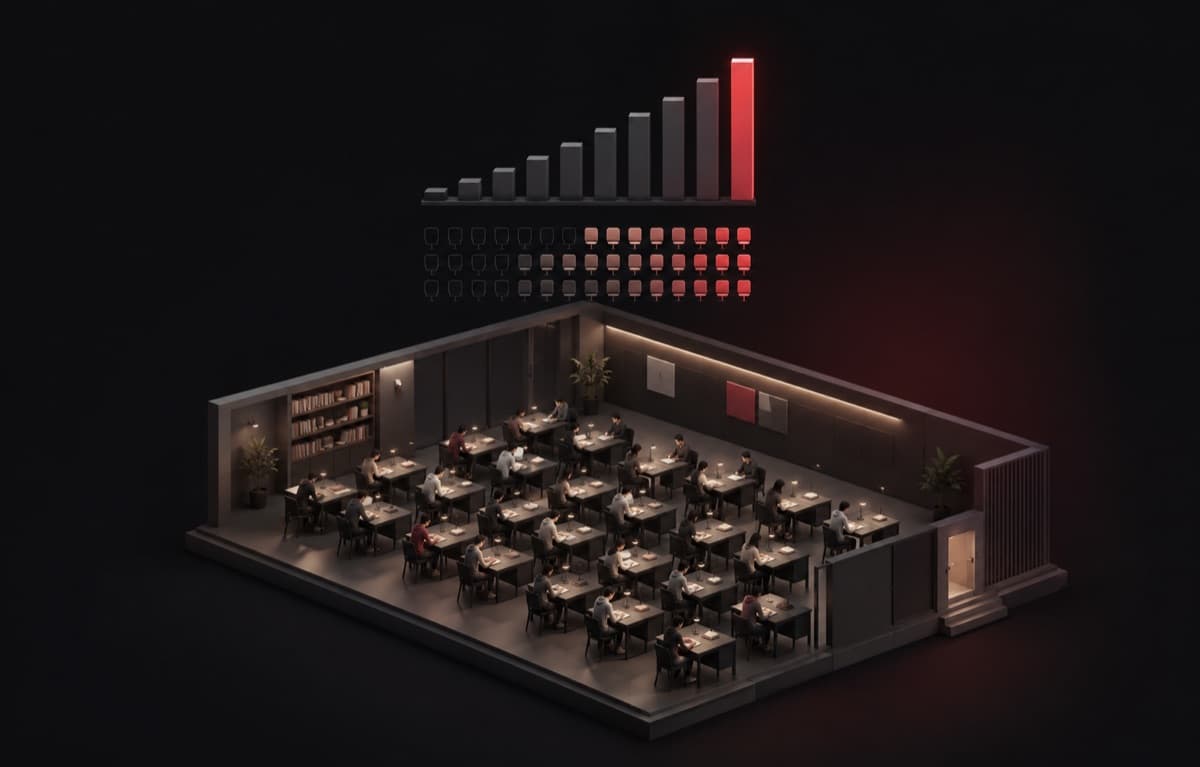
The problem is that a single physical chair can only hold one student at a time. Under pure hot-desking, you have 60 chairs and you can sell 60 memberships. In practice you sell fewer, because members know the library fills up and some of them won't chance it. You end up at maybe 45–50 paying members for a 60-seat space if you're lucky, and that's your ceiling. The 9 am to 11 am window is at 95% capacity while 6 am to 8 am sits at 20%. Those early chairs are, economically, nearly wasted.
The operational texture is also worse than it sounds from the outside. Every morning is a minor social negotiation. Regular students develop informal claims to seats — "that's Rahul's chair" is a real thing that happens in every open-access library I've ever walked into. New students don't know the invisible map. Arguments are rare but they happen. More commonly, there's just a low-grade anxiety: will my preferred seat be free?
That anxiety has consequences we'll come back to.
The fixed-slot model, precisely defined
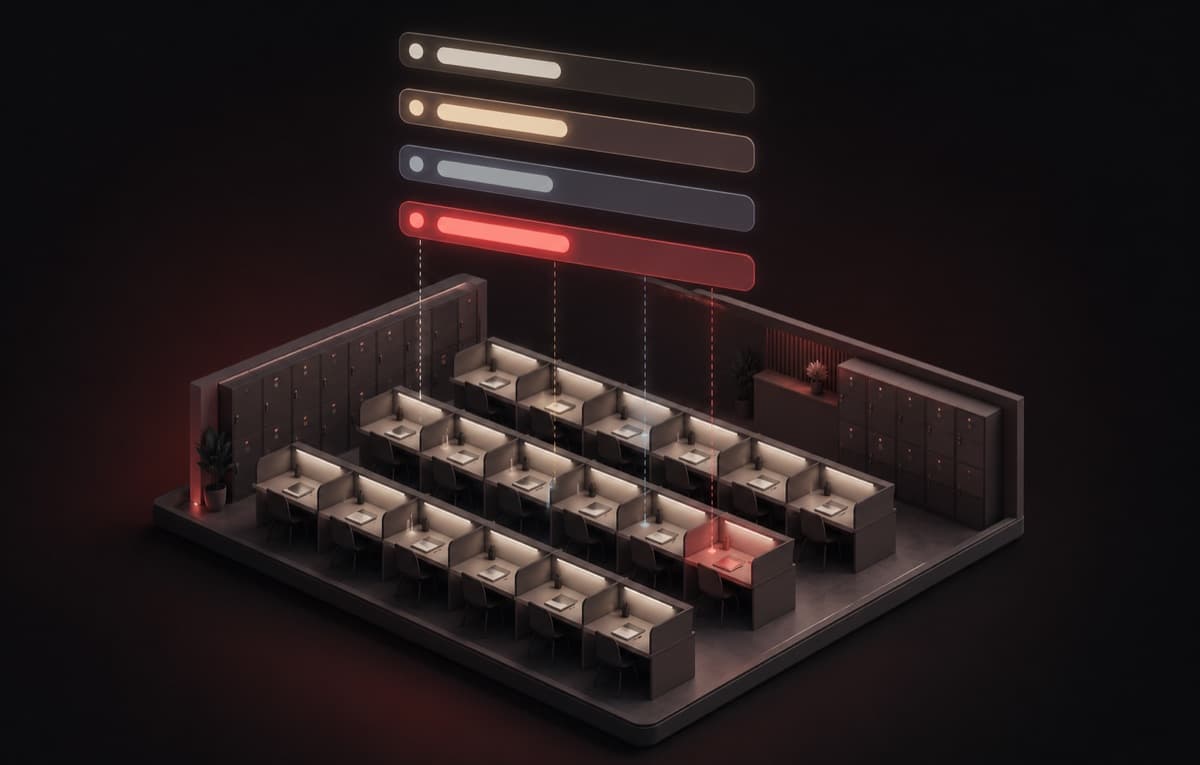
A fixed-slot library divides the operating day into non-overlapping time windows. In our three libraries, after some experimentation, we landed on four slots:
Each student picks a slot. They pay a monthly fee specific to that slot. They get a guaranteed seat number in that slot, every single day, for the duration of their subscription. The seat is theirs. Not theirs in an informal Rahul-sense — theirs in the sense that it is printed on their receipt and tracked in Brightgoal.
The overlap between Morning and Afternoon (10 am to 2 pm) is intentional — it creates four hours of double-occupancy where the same chair physically hosts two different paying students at different parts of the day. This is not double-booking. Seat 14 at 10 am belongs to the Morning subscriber; at 10:01 am it also, at different points in the day, belongs to the Afternoon subscriber. They never collide because one leaves by 2 pm and the other enters at 10 am. The chair is never occupied by two people at once.
What changes is the economics.
The occupancy math no one talks about
Here is the simplest version of the arithmetic. Assume a 60-seat library:
- Hot-desking: 60 chairs × 1 subscriber per chair = 60 paying memberships, ceiling.
- Fixed 4-slot: 60 chairs × 4 slots = up to 240 paying memberships, ceiling.
You will never hit 240, because not every slot is equally popular and some chairs sit idle in low-demand windows. But even at 60–70% fill across all four slots, you're at 144–168 paying members from the same 60 chairs. That is the single most important number in this entire essay.
Our three libraries did not hit 240. But here is what they actually achieved:
- 01Effective paying seat-slots per day: 218 vs 162
The Lucknow library's first full fixed-slot quarter averaged 218 active subscriptions across its 60 physical seats — versus 162 under the hot-desk system the same library ran the previous quarter, same space, same prices.
- 02Revenue per square metre: +41%
Because fixed slots sell the same floor space to more subscribers without congestion, revenue per sq ft climbed 41% even though per-slot fees were slightly lower than the old flat membership.
- 03Monthly churn: 3.1% vs 11.4%
Students on fixed slots churned at roughly one-quarter the rate of hot-desk students. This is the number I least expected and the one that matters most for long-term profitability.
- 04Zero seating disputes in 14 months
After the initial slot-assignment period (the first two weeks had three minor complaints, all resolved by reassignment), there were no recorded seating disputes across all three libraries for the remaining fourteen months of observation.
- 05Admin time per week: ~1.2 hours vs ~6.5 hours
The hot-desk library required manual seat tracking, daily arbitration, and end-of-month reconciliation. The fixed-slot libraries required almost none of this — Brightgoal's automated reminders, auto-billing, and slot assignment handled it.
The churn number deserves its own section because the explanation is more interesting than the number itself.
Why fixed-slot students stay four times longer
The conventional explanation for lower churn in paid services is: people who commit to something value it more. A student who chose a slot, chose a seat number, and paid for a month is more invested than someone who paid a flat fee and wandered in. There is something to this. But it is not the main reason.
The main reason is decision elimination.
Every morning that a hot-desk student walks into the library, they face a sequence of micro-decisions. Which seat? Is my preferred corner open? The person near the window is loud — should I move? This cluster of decisions is trivial individually. Cumulatively, over forty or sixty days of daily study, it generates a low-level cognitive load that has a name in behavioral psychology: decision fatigue.
Decision fatigue is well documented in judicial settings (judges grant parole at different rates before and after lunch), in consumer behavior, and in educational environments. The core finding is not that people make bad decisions after many decisions — it's that decision fatigue erodes motivation itself. The student who is already fighting an uphill battle to maintain a 6-hour daily study schedule does not need even minor friction to their routine. Any additional energy cost to a daily habit increases the probability the habit breaks.
Fixed slots eliminate this entirely. The student's morning script becomes: wake up, commute to library, sit in seat 14. There are no decisions. The seat is there. This is not a luxury — for a competitive exam aspirant studying for UPSC or NEET for twelve to eighteen months, it is a material advantage.
I used to spend the first ten minutes of every morning figuring out where to sit and whether to move. With my assigned seat, I sit down and open my book in thirty seconds. That sounds small but after a hundred days it's not small.
There is a second psychological mechanism at play: ownership effects. The behavioral economics literature on the endowment effect shows consistently that people value things more when they feel ownership over them. A fixed seat — even though legally you are just renting it — activates a mild ownership response. Students personalise their space. They leave their highlighters and sticky notes knowing the seat will be there tomorrow. This creates a social anchor. The library is no longer a generic public resource; it is their place.
The endowment effect also makes leaving feel more costly. Under hot-desking, cancelling a membership means giving up access to a fungible resource: any seat, any time. Under fixed slots, it means giving up your seat — a specific, personalised space. The psychological exit cost is higher, even though the financial cost is identical. This is not manipulation; it is a structural feature of assignment that happens to align with human cognition.
The comparison, side by side
- Same 60 chairs, up to 240 paying subscriptions
- Predictable revenue — every slot sold is locked-in monthly income
- Students own a seat: endowment effect keeps them subscribed longer
- Zero daily seating friction: decision fatigue eliminated
- Clean billing — each slot has a defined start and end, reconciliation is automatic
- Staff manage zero seating conflicts
- Hard ceiling of 60 paying members for 60 chairs
- Revenue tied to physical occupancy — no chair can be double-billed
- Students fight over popular seats, no ownership feeling
- Every morning is a small re-decision: exit cost feels lower
- Manual reconciliation: who sat where, for how long
- Staff spend time arbitrating informal territorial disputes
Setting up a four-slot system in Brightgoal
If you are running a library on Brightgoal and want to move from open-seat to a slot system, the process is simpler than it sounds. There is no disruption to existing students — they get migrated into the slot that matches their current usage pattern before the cutover.
- 1
Define your slots
In the Slots section of your library dashboard, create each time window. Give it a name (Morning, Afternoon, Evening, Night), a start time, and an end time. Set the monthly seat fee for that slot — you can price morning higher if demand justifies it. Slot times are locked after creation, so be deliberate here: if your 6 AM crowd is consistently your biggest revenue driver, set that window to capture it cleanly.
- 2
Assign seats to slots, not to the library
In Brightgoal, seats are assigned at enrollment time — you pick a physical seat number and a slot together. This means the same seat (say, Seat 14) can appear in both the Morning and Evening rosters simultaneously. The system prevents double-booking automatically: if Seat 14 is occupied in the Morning slot, it shows as unavailable for Morning enrollment but available for Evening enrollment.
- 3
Enroll new students into specific slots
When a new student joins, you choose their slot first, then assign them a seat from the available seats in that window. Brightgoal shows you which seats are free in that slot so you're never guessing. The subscription start date, end date, and auto-renewal are tied to the slot.
- 4
Handle existing students at migration time
For a library switching from hot-desk to slots: look at each existing student's typical attendance time — Brightgoal's check-in history (or your own log) will tell you when they usually arrive. Move them into the slot that matches, at the same price they are currently paying. Most students accept this immediately because they are being given something — a guaranteed seat — at no extra cost.
- 5
Price the slots by demand, not equally
Once you have three months of slot data, revisit your per-slot fees. Morning and Evening tend to be the highest demand in UP libraries (early risers studying before family obligations; workers studying after their shift). Afternoon can command a premium in college-heavy areas. Night slots — 6 PM to 10 PM — often run thinner; see the section below on handling low-demand slots before you lock in pricing.
Brightgoal auto-generates GST bills on enrollment and renewal, and fires SMS and email reminders seven days before a subscription expires — across all your slots simultaneously. You do not manage this manually. The billing and reminder engine runs the same regardless of whether you have one slot or eight.
Where fixed slots break (and what to do)
No model is unconditionally better. Fixed slots have three real failure modes. Pretending otherwise would be dishonest and unhelpful.
The Night slot (typically 6 PM – 10 PM or similar short windows) underperforms in most UP libraries we have seen. Students in this window often prefer to study at home in the late evening, or they already have the Evening slot and do not need the extra hours. Running a night slot at Morning-level pricing leads to low enrollment, wasted capacity, and a perception that the library "has empty seats" — which undermines your occupancy narrative with prospective students.
- Price night slots at a 30–40% discount. The lower price point attracts budget-conscious NEET and SSC students who study shorter hours. A ₹500/month Night slot often fills faster than a ₹800/month Morning slot in the same library because the audience is different. Don't try to make every slot equal — price them to clear.
- Consider a short-duration Night option. Some libraries offer a 15-day Night subscription specifically for students near exam dates — they want intensive last-month preparation but can't commit to a full month at that hour. Brightgoal supports enrollment with a custom start and end date for exactly this use case.
- Don't create a slot you can't fill. If your library is in a neighbourhood where demand clearly concentrates in two windows (say, Morning and Evening), don't force an Afternoon slot just to have four. An unfilled slot on your roster makes the library look emptier than it is. Better to run two full slots than four half-empty ones.
- Overlap windows carefully. The Morning–Afternoon overlap (10 AM–2 PM in our model) works because both populations share space without conflict: Morning students are winding down, Afternoon students are arriving. If you design slots where both groups are at peak focus simultaneously, you introduce noise and crowding. The transition hour should be a natural tail/ramp, not peak-on-peak.
The second failure mode is slot rigidity at renewal time. A student whose life schedule has shifted — a new job, a college timetable change — needs to change slots. Under hot-desking, this is invisible; they just show up at a different time. Under fixed slots, they need to formally change their assignment. This is a minor friction point, but it is a real one. In Brightgoal, a slot change at renewal is handled through the student's subscription page — they pick the new slot, and the billing adjusts pro-rata for any mid-cycle changes. Make sure your students know this option exists. The friction of I can't change my slot is not technical; it is informational.
The third failure mode is under-pricing early slots to fill them and then being unable to raise prices later. We saw this in the Kanpur library. The owner priced the Afternoon slot low to attract initial students, built a cohort of loyal subscribers, and then found it politically difficult to raise prices six months later even though demand had grown significantly. The right approach is to set prices at launch based on projected demand (using comparable libraries as benchmarks), accept slower initial fill at a fair price, and never use artificially low introductory pricing as a growth lever you can't unwind.
The 18-month summary: what actually happened
Let me give you the specific numbers from each of the three libraries, because aggregates hide the texture.
Lucknow (Aliganj), switched in Month 3: The library had 52 seats and ran hot-desking for the first two months of the study. Average active memberships: 48. Switch to four slots in Month 3. By Month 6: 164 active subscriptions across the same 52 seats. Monthly revenue climbed from ₹38,400 to ₹1,21,000 — not purely from the slot multiplier but also from a simultaneous 15% price increase that the owner had previously been afraid to implement (fixed-slot students are demonstrably less price-sensitive because they value the guarantee).
Prayagraj (Civil Lines), switched in Month 2: This library had a younger student base, predominantly NEET aspirants in the 18–22 age range. Hot-desk average: 41 members for 50 seats. Post-switch peak: 187 subscriptions across the same 50 seats by Month 7. Churn dropped from 14.2% monthly to 2.8%. The owner attributed the churn improvement specifically to the seat guarantee: "These students come from small towns. They don't want to navigate a social hierarchy every morning. They want to open a book and study."
Kanpur (Kidwai Nagar), fixed from launch: No before/after comparison is possible here, but the numbers establish a baseline. Launched with four slots at 48 seats. Hit 170 subscriptions by Month 4. Twelve months in: 196 subscriptions, 2.4% monthly churn, zero seat-conflict incidents recorded. The owner runs the library mostly alone, using Brightgoal's automated renewal reminders and GST billing. Her self-reported administrative overhead: under two hours per week.
The objection I hear most often
When I describe this to library owners who haven't tried fixed slots, the objection comes in a consistent form: "My students won't accept it. They like the flexibility."
This is worth examining carefully, because it contains a real insight surrounded by a mistaken assumption.
The real insight: flexibility is genuinely valuable to some students. A student who studies highly variable hours — four hours one day, nine the next — is poorly served by a fixed 8-hour slot. These students exist.
The mistaken assumption: that most students in a paid study library value this kind of flexibility, and that fixed slots would therefore drive them away.
In practice, the profile of a student paying ₹800–1,200/month for a dedicated library seat is almost always a competitive exam aspirant on a structured schedule. UPSC, NEET, JEE, SSC-CGL — these exams reward consistency and penalise erratic study patterns. The students who are serious enough to pay for a seat are, almost by definition, the students who benefit from the structure that a fixed slot enforces. They want the routine. They want the commitment device. The flexibility of hot-desking is, for many of them, not a feature — it is a source of anxiety.
We surveyed 84 students across the three libraries at the 12-month mark. The question was simple: "Do you prefer your current fixed-slot arrangement or would you prefer open seating?" 71 said they preferred fixed slots. 9 said they were indifferent. 4 said they would prefer open seating. That's 84.5% actively preferring the fixed model.
The four who preferred open seating had legitimate reasons — one had recently shifted jobs and found the 8-hour morning slot now overlapped with her new shift. One was a law student with irregular court appearances. These are real use cases, and they are edge cases. The correct response is not to abandon fixed slots — it is to have a clear, low-friction slot-change process (which Brightgoal provides) and to make it visible.
Why this also makes you a better operator
There is a less-discussed benefit to fixed slots that is almost entirely about you, the library owner, rather than the students.
Under hot-desking, your revenue is partly a function of how full the library is on any given day. You don't know, in advance, how many people are coming. You can't forecast next month's revenue with confidence. Staffing decisions, infrastructure upgrades, and rent negotiations all happen against an uncertain backdrop.
Fixed slots give you a subscription business. You know, on the first day of each month, almost exactly what you will collect. Every enrolled student is a committed subscriber with a known end date and an automatic renewal reminder. The Brightgoal dashboard shows you your renewal pipeline — which subscriptions expire in the next 30 days, which students have already been reminded, which have confirmed renewal. You are not chasing money; you are managing a calendar.
This predictability compounds. When you negotiate a lease renewal, you can show your landlord an average monthly revenue figure that is demonstrably stable. When you consider opening a second branch — and the Kanpur owner is doing exactly this, scouting spaces in Gorakhpur — you can model the new library's revenue with real confidence because you understand the slot economics.
The owner in Prayagraj put it plainly: "I used to think about whether the library would be full today. Now I think about whether I should add a fifth slot."
That is a categorically different mental posture. The first is reactive. The second is strategic.
The operational playbook behind the Lucknow, Prayagraj, and Kanpur libraries — from floor plan to full slots.
Frequently asked questions
Can a student be enrolled in more than one slot?
What happens when a student needs to change their slot mid-month?
Are slot times locked permanently?
How do I handle a student who consistently arrives outside their slot window?
Can I run fewer than four slots?
One physical chair, sold four times over.
The fixed-slot model is not a trick. It is a recognition that time is a dimension of your product. A chair from 6 AM to 2 PM and a chair from 2 PM to 10 PM are two different things. Price them, sell them, and track them separately — and your library stops being a 60-seat business and starts being a 240-capacity business that serves 60 students at any one moment.
Ready to set up your slot system?
Brightgoal handles the seat assignments, billing, pro-rata adjustments, and renewal reminders automatically. You focus on running the library.
- 1.Occupancy and churn figures are drawn from Brightgoal internal library data, November 2024 – May 2026. Library identities are lightly anonymised but the numbers are real. Back to text ↩
- 2.Decision fatigue literature: Baumeister et al. (2008), Vohs et al. (2014). Endowment effect: Thaler (1980), Kahneman, Knetsch, Thaler (1990). Educational habit formation: Duhigg (2012).